

Introduction
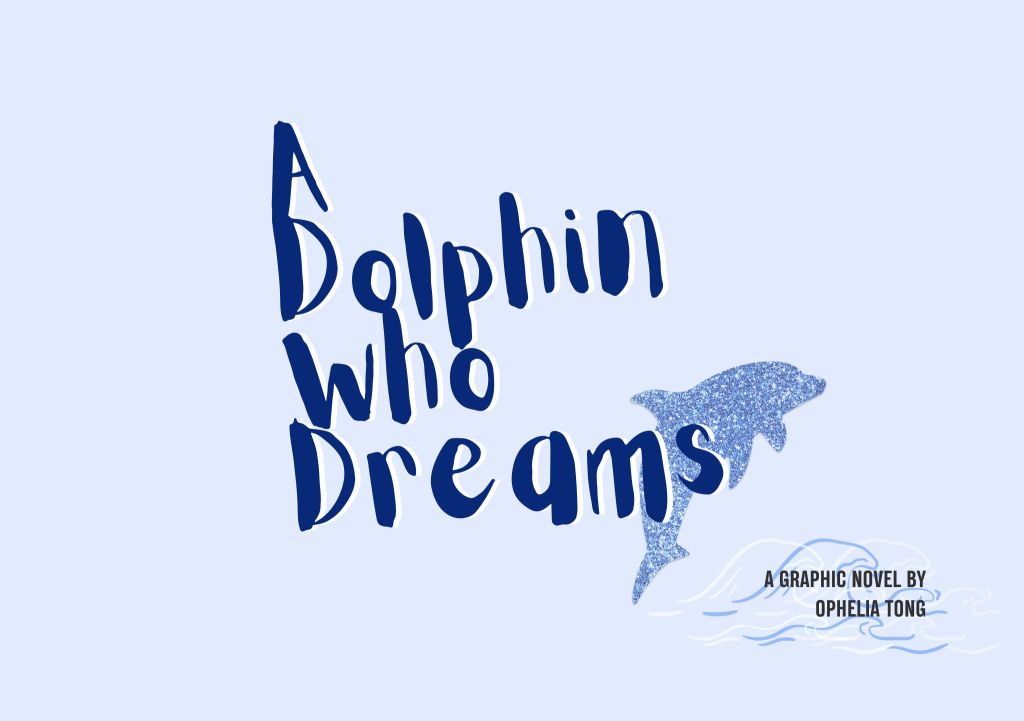
Human violations of animal rights are the manifestation of and justified by, structurally rooted ideologies of human supremacy. In the children’s graphic novel, “A Dolphin Who Dreams”, I told the story of a dolphin I named Kiki and her dreams of home. Through the use of human language, I aimed to personify Kiki and therefore criticize animal captivity by contradicting human supremacy. In contrast to the audience and the actress who are nonchalant about Kiki’s captivity, a little girl points out the cruelty of the dolphin show. This suggests that desensitization to these practices through human supremacist culture occurs, as children are more aware of overt cruelty than adults around them. Kiki enters the little girl’s dream, where the roles of the girl and Kiki are reversed. The reversal of roles implies the simplest idea: no one loves living in captivity, and it also implies the need for more radical, transformative, and systemic changes to end human supremacy as a mainstream ideology today. The inspiration for my illustrations comes from one illustration in Sue Coe’s graphic novel Zooicide, in which Sue depicts an imaginary role reversal between a man and a gorilla, where the gorilla performs a mirror test on the man’s awareness. Through an analysis of the characters and narratives, this commentary discusses how my graphic novel presents that animal captivity violates animal rights, and unpacks its relationship with human supremacy within colonial capitalist culture.
Keywords: self-awareness, animal rights, animal captivity, human supremacy
Animal rights and Human Supremacy
Animal rights are rights inherent to non-human animals, which include the right to food, water, natural habitat, freedom, and other fundamental aspects of their lives. As Derrick Jensen puts it, animals are sentient beings with their own “personalities, relationships, and lives” (Jensen 267). Animal rights are based on the principle that every animal exists for their own sake, rather than to serve human ends. However, due to human supremacy which sees all animals as existing to serve humans, animal captivity in the name of human entertainment is a commonly seen violation of animal rights in today’s society. Captive animals lose their right to health, natural habitats, freedom, and ability to sustain themselves. They are confined in artificial environments that do not provide the necessary space, resources, and social interactions required for their physical and psychological well-being. They always suffer from poor mental and physical conditions and eventually die due to the loss of rights mentioned above. This can particularly be exemplified by my illustrations, where Kiki sufferers from “captivity-induced nostalgia,” and constantly dream of her life in the wild.
Animal rights violations and human supremacy are interconnected. The former manifests through human supremacy, and the latter justifies it. The concept of human supremacy implies that humans are superior to other species and can exploit them. As Jensen unpacks, “civilized man is far more perfected than ‘primitive’ man, who is barely removed from animals” (28). Human supremacy reproduces the Great Chain of Being, a hierarchy of perfection where humans are higher than non-humans. Also, the defenses for human supremacy are tautological, which means circular and self-reinforcing. According to Jensen, “Human supremacists set themselves as the standard by which all others are judged” (33). These defenses make human supremacy the dominant ideology in society, and the majority of humans utilize it to justify treating animals as things to use for food, clothes, testing, fun, or whatever else they want. My graphic novel uses animal captivity illustrations to imply and unpack the toxic relationship between animal violations and human supremacy.
Character and Imagery Analysis
Kiki the Dolphin
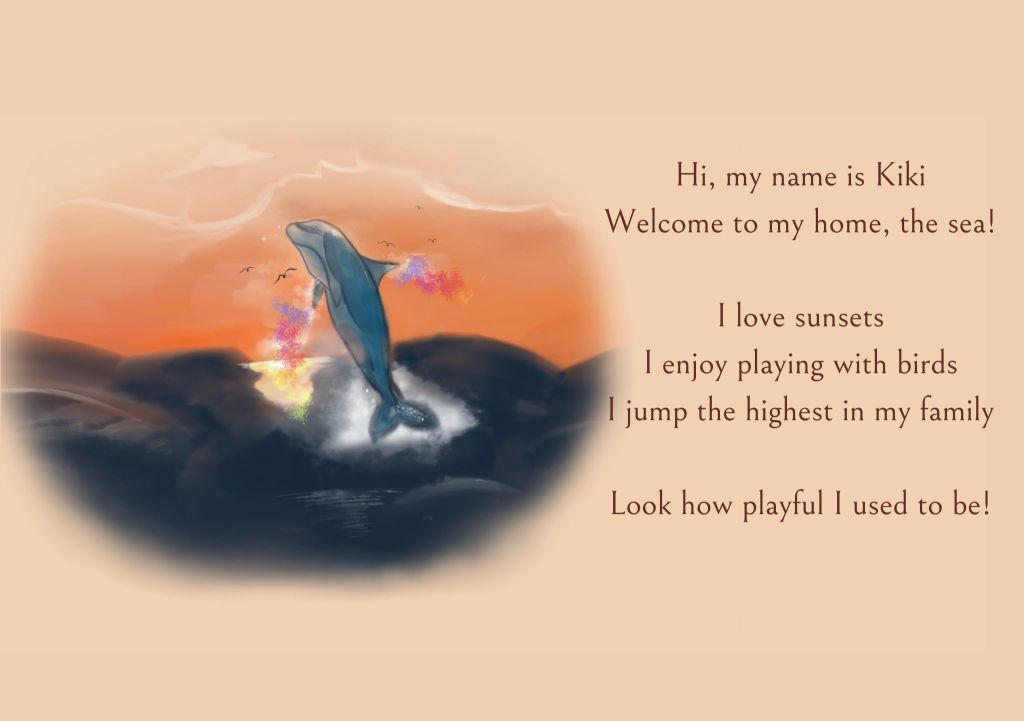
In my story, Kiki the dolphin is the protagonist and narrator. The intentional choice of this point of view aims to signify that animals live as sentient and as actively as humans. As shown in my first illustration, Kiki is a playful living being whose fundamental rights are fully embodied while leaping out of the ocean. Free, happy, healthy, and self-sufficient, she enjoys swimming with families and playing with birds. The sunset as the background of Kiki’s diving might evoke a sense of childlike wonder in how beautiful the natural habitat Kiki used to live in was.
However, when Kiki becomes captive, the joy she felt in the wild becomes a reminiscence of her freedom, something she can only dream of now. In the next illustration, she loses her autonomy. Particularly, her right to freedom. Animals’ right to freedom is one of the fundamental rights commonly subjected to human violations today. I depict Kiki leaping out of the water in the first illustrations but glimpse into two completely different worlds. Specifically, in the first illustration, her diving posture is nearly vertical with effortless grace. Yet, when a “princess” (actress) steps on her head in the dolphin show, her posture implies she has no freedom.
Audience and the Actress
The second illustration brings animal violations under the spotlight, together with human supremacy. First, the elevated position of the “princess” compared to Kiki embodies human supremacy. Since humans are “higher” on the hierarchy of existence than animals, they feel as though they can step upon their heads. The “princess” is merely a performer, who works for the true perpetrator of violence: cruel institutions such as capitalist aquariums, zoos, and safaris. She represents all those who profit from trampling on animal rights, which also reflects that there is not simply one person who can be blamed. Besides, the imagery implies human supremacy’s socialization of people. As members of a human-centric society, adult audiences are enjoying the show and take pictures. Neither of them exhibits any hint of sympathy towards Kiki. They are nonchalant about the fact that she was once a free and vibrant being. Human supremacy socializes people by commodifying animal exploitation and then marketing it as a family experience, education, conservation, etc. Thus, the audience finds nothing wrong with Kiki’s loss of natural instincts and rights. For them, Kiki is merely an inanimate object to fulfill their entertainment needs.
Human supremacy socializes people into the toxic mindset mentioned, but another question remains. How did human supremacy evolve into a seemingly indestructible ideology that dominates today’s society? Jensen answers the question by listing defenses for it, such as language, big “brain-to-body-ratio”, and self-awareness. Human supremacists use these human characteristics to judge animals’ lack of self-awareness. And therefore, they are passive, insentient, and inferior to humans. My graphic novel contradicts these defenses by exhibiting Kiki’s self-awareness and agency in captivity. Kiki’s dream underscores the cognizance of her captivity, loss of communities and freedoms, and human cruelty. In the second illustration, Kiki dreams of her joyful reminiscence in the wild. I depict her effortless jumping in the wild as the background of the compelled jump in the show to provide a stark contrast. Moreover, Kiki is aware of her captivity. The repeated “I dream about [her previous home and communities]” declares her sense of nostalgia triggered by captivity. Moreover, linguistic abilities make the next defense for human supremacy. Human supremacists assert that few animals have languages as humans do, and thus humans are superior and can exploit animals. They also abuse the scientific fact that humanity’s brain-to-body ratio surpasses that of dolphins (Huggenberger 1103). However, Kiki acquires human language “very soon”, while human keepers call her “a dolphin” without even knowing her name. Overall, Kiki’s dream and acquisition of language deconstruct the human supremacists’ assertion that animals lack awareness and intelligence.
The Little Girl Who Questions Human Supremacy
In contrast to the oblivious audience, a little girl questions animal exploitation. Her face reflects a mix of horror and sadness as she witnesses the brutal mistreatment of animals unfolding before her. The girl’s empathy towards Kiki serves as a powerful challenge against human supremacy. She raises three questions with anti-human supremacy implications. “Why do they keep her here?” symbolizes challenges to the rationale of Kiki’s captivity. “Is she happy doing that?” signifies the girl’s intrinsic belief that humans need animals’ consent and cannot force Kiki to perform. “Does she hurt?” exhibits how the little girl finds that even a “princess” stepping on Kiki’s head is inhuman. What’s also worth noting is that the girl refers to Kiki as “she/her”, demonstrating that she recognizes Kiki as a sentient being, not an object like human supremacists do. Rather, she views Kiki as a sentient being who has been enduring great pain of mistreatment and the loss of her freedom and well-being. Being the only one standing in Kiki’s shoes, she challenges human supremacy as the justification for animal captivity, which she finds harmful to animals’ well-being.
Role Reversal of Kiki and the Girl
With an understanding of human language, Kiki hears the little girl’s question, and then Kiki, “a dolphin who dreams”, enters the girl’s dream. When Kiki says to the girl “Yes, it does” Kiki confirms the cruelty of human supremacy by responding to the little girl’s questions, “It [a human stepping on me] hurts very much.” The third illustration deconstructs human supremacy by conveying a simple principle: No one likes being held captive. In the dream, the roles of the girl (a human) and Kiki (representative of animals in captivity) are reversed.
As discussed above, “self-awareness” defends human supremacy. Particularly, the mirror test is often conducted on non-humans to see if they recognize themselves in the mirror. The test has been favored as the “gold standard” by many human supremacists since few non-humans could pass (Jensen 266). In Sue Coe’s work, Zooicide, Coe depicts a gorilla holding a mirror in front of a man to see if he is self-aware. Coe’s hypothetical role-switching between humans and animals inspires my last imagery. In the final illustration, I draw the little girl crying and sleeping in the aquarium while Kiki is outside watching her. This might evoke a sense of suffocation among readers, which prompts them to reflect on animal captivity. Kiki asks the girl why she is crying. “Because I am trapped. I want to be free.” the girl’s reply and the role-switching unveil the simplest irony: no humans like being captive, but how can we keep animals so?
In the end, Kiki realized that the dream she had been experiencing was not the girl’s dream, but her own. “Oh, wait…, it is another dream of mine.” This realization connects to the title of the work, “a dolphin who dreams”. More importantly, it exposes readers to the fact that animal violations have been parasitized on human supremacy and grown into a systemic issue. Other than that, human supremacy normalizes animal abuse and socializes people. Its dominant position is made possible by tautological defenses on language, brain size, self-awareness, and so on. But the tone of the ending is not intended to be pessimistic. Rather, the goal of the novel is to highlight the urgent need for radical and transformative action to end animal enclosures. It prompts readers to understand human supremacists’ tautological defenses. With these defenses, human supremacy normalizes and rationalizes animal abuse. It has been so entrenched in our society that it socializes people to be oblivious to animals suffering. The story reminds people that human dominance over living beings like us is nothing rational. We need to jump out of the box of human supremacist ways of perceiving the world. As re-emphasized at the end of the story, to deconstruct human supremacy, we must engrave the simplest principle that “no beings like to be captive”, boycott all forms of animal captivity and rehabilitate those in captivity at the present. The little girl and activists have been waiting for more allies.
Conclusion
In conclusion, “A Dolphin Who Dreams” is a children’s graphic novel that explores the relationship between animal violations and human supremacy. Through Kiki the dolphin’s dreams of leaping in the sea, the novel illustrates the loss of freedom, a fundamental animal right. Audience nonchalance shows that human supremacy justifies animal abuse and socializes people into the human-centric worldview. Kiki’s dream and her ability to acquire human language deconstruct defenses for human supremacy. The questions the little girl asks also challenge animal violations and the notion of human supremacy as a justification. Kiki’s dream of role reversal emphasizes that no being wants to be captive. Importantly, the novel demonstrates that ending animal captivity requires radical and transformative action to dismantle human supremacy, a dominant ideology in our society.
Work Cited
Huggenberger, Stefan. “The Size and Complexity of Dolphin Brains–a Paradox?” Marine Biological Association of the United Kingdom.Journal of the Marine Biological Association of the United Kingdom, vol. 88, no. 6, 2008, pp. 1103-1108.
Jensen, Derrick. “The Great Chain of Being”, The Myth of Human Supremacy, Seven Stories Press, 2016, pp. 23-35.
Jensen, Derrick. “Self-Awareness and the Apocalypse”, The Myth of Human Supremacy, Seven Stories Press, 2016, pp. 266-274.
 oph
oph 
Leave a comment